|
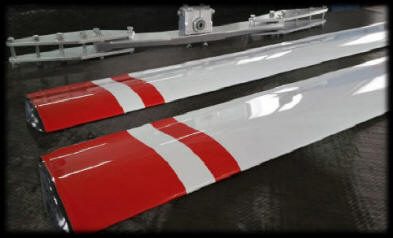
The DA Rotors composite blades utilize a 4130
Chromium-Molybdenum alloy spar system. This spar and root system
consists of 34 parts, all 4130 chrome moly and tig welded together.
This alloy is one of the most widely used aircraft steels because of
its combination of weldability, ease of fabrication and mild harden
abilities. The spar consists of four 4130 tubes, ribs and straps. The
strongest of these tubes runs along the entire length of the blade
at 25% chord. The tensile strength of all tubes are
90,000 PSI. The ribs and straps used are all 4130 and have a tensile
strength of 75,000 to 85,000 PSI. The leading edge is also 4130,
preventing crushing and twisting of the blade if impacted. The root
section of this blade consist of 17 of the 34 total parts and has a
tensile strength of 85,000 PSI.
This spar and root system posses the best lineal and torsional
rigidities in the industry.
The Skins of this blade are made of many types of fiberglass,
Kevlar, Carbon Fiber and hybrid Carbon/Kevlar cloths. We use an
Epoxy Resin system; this also adds to the blade's strength and long
life. You can purchase many different configurations of cloths for
these blades. The S-2 glass blades are our basic model and consist of 6
layers of diagonal and non-diagonal weaves—all in S-2 cloths and
in many pigmented colors that are added into the epoxy resin.
The Carbon Fiber, Kevlar and Carbon/Kevlar skins have no pigments
and are used with a clear Epoxy Resin to show the cloth's weave.
S-2 Fiberglass has high tensile strength, high heat &
chemical resistance and is dimensionally stable. The resulting
composite fabric meets or exceeds military, aerospace, and other
relevant specifications. The breaking strength of S-2 (lb/in) Warp:
221 lb/in, Fill: 235 lb/in. This style of S2-Glass is identical to
E-Glass, except it is woven with superior S-2 fibers resulting in
extraordinary strength with a superior look and finish.
Kevlar blades. These blades are made using kevlar twill weave
and S-2 Diagonal and non-diagonal weave cloths. The top layer is
kevlar and the inner layers are of S-2 diagonal and non-diagonal
weave, giving this blade the best impact resistance. This
can also be added as a leading-edge protection to the S-2 blades and
the carbon fiber blades.
Kevlar® Twill Fabric This Kevlar® fabric provides the
improved cosmetics and durability of a twill weave. Ideal for
impact resistant applications requiring the lightweight, high
strength properties of Kevlar® where pattern show-through is
desirable. Warp Raw Material 1140 denier Kevlar 49, Filling Raw
Material 1140 denier Kevlar 49, Weave Pattern 2 x 2 Twill, Fabric
Areal Weight 5.3 oz/ yd2, Warp Ends/ Inch 17 epi approx. Pick /
Inch 17 ppi approx. Nominal Thickness .011 inches
Carbon Fiber Blades. these blades are a favorite among our
customers because of their high-end look. The top
two layers are Carbon Fiber twill weave with 4 layers of diagonal
and non-diagonal weave S-2 Fiber glass. Done with clear epoxy resin.
Carbon Fiber Twill Weave Fabric Graphite fibers contain up to
95% carbon and yield the highest tensile strength in the FRP
industry. These fibers woven together form graphite fabric. These
fabrics offer higher strength and stiffness-to-weight ratios than
any other commonly available reinforcements. While there are
hundreds of types to choose from, we have selected three styles of
standard modulus carbon fiber which are suitable for use in racing,
aircraft, competition marine, and light industrial applications. To
maximize the fiber properties we only use epoxy resin, This 2x2
twill weave fabric offers the cosmetic appearance so desirable on
modern composite parts. But it isn't just used for looks: this fabric
is highly formable and slightly stronger than the plain. Warp Raw
Material 3K – Multifilament Continuous Tow. Filling Raw Material 3K
–Multifilament Continuous Tow. Weave Pattern 2 x 2 Twill, Fabric
Areal Weight 5.7 oz/yd2 (200 gsm approx.). Warp Ends/ Inch 13.0 ±
1.0. Pick/Inch 13.0 ± 1.0. Nominal Thickness .012 inches.
Carbon/Kevlar Blades. These blades are also desirable because
of the different weave pattern they have with the black carbon
fibers running in one direction in the weave and the red, yellow or
blue kevlar running in the opposite direction. The top layer is
Carbon/Kevlar and the other 5 layers are S-2 diagonal and non-diagonal weave cloths and are used with clear epoxy resin.
Carbon/Kevlar Hybrid red, blue and yellow fabric. 012" Thick,
2 x 2 Twill Weave These first quality, hybrid fabrics offer 3K Carbon
in the warp and 1500 Denier Kevlar in the fill directions for
maximum drapability and drop-dead good looks. Use as a single layer
for cosmetics only or back with another layer in the cross direction
for a maximum balance of properties. The Kevlar fibers are dyed with
red, blue or yellow dyes for eye-catching color. Warp Raw Material
3K –Multifilament Continuous Tow. Filling Raw Material 1420 Denier
Kevlar 49. Weave Pattern 2 x 2 Twill. Fabric Areal Weight 5.4 oz/yd2 (193 gsm approx.). Warp Ends/ Inch 13.0 ± 1.0. Pick/Inch 14.0
± 1.0. Nominal Thickness .013 inches.
Desert Storm Camo Chroma-veil blades. If you like that
military look then these are the blades for you. These are
camouflaged printed into the cloth. Chroma-veil is a non-woven
synthetic fabric printed in a series of unique patterns. Chroma-veil
is designed to be used behind a high-quality clear gel coat and in
in-mold composite fabrications. There are many Chroma-veil patterns
to choose from if you have a pattern you would like us to use then
just let us know.
Chroma-veil fabric is very soft, pliable and can be used in
extremely tight radii and corners without relief cuts or pleats.
Chroma-veil™ has excellent tensile strength and elongation
properties and can withstand the rigors of most lay-ups without
tearing, shredding or harming the pattern. The addition of resin
does not significantly change the properties of Chroma-veil. Basis
Weight .9 -1.3 oz/sq yd. 31-44 g /sq m. Caliper 7 – 12 mil. 0.18 –
0.31 mm. Grab Tensile MD 22 -24 lb, 10 – 10.9 kg. XD 11 -14 lb, 5.0
- 6.4 kg. Elongation @ Break MD 33% - 50%. XD 75% - 119%. Modulus @
10% Elongation, MD 6 – 9 lb 2.7 – 4.1 kg. Fiber Elongation @ Break,
25%. Fiber Softening Point, 460° F, 250° C.
Non-core trailing edge.
We use No core for the trailing edge of our blades. We do not use
Nomex honeycomb in our blades. Nomex is not intended for aviation
uses and should never be considered as a viable aircraft building
material. We use carbon fiber ribbing drilled out for ambient
ventilation. This will not allow heat to build up pressure in the
trailing edge of the blades and distort the profiles geometry. So
these blades will hold there geometry in either hot or cold weather.
Bonding material. The bonding material is the heart of the
blade. It must be carefully thought out and executed to avoid
failure. We use a bonding material that we have found to be one of
the best available. Its high viscosity allows for excellent gap
fitting and great adhesion to many metals and foams. This bonding
material does not warp after curing and has a full cure time of 6 to
8 hours. This helps speed up blade production. Gel Time, 4 fluid
ounces, @ 77° F 25: 30 minutes. Cure Time @ 77° F: 6 to 8 Hours, @
140° F: 45 to 60 Minutes. Handling Strength, 3 to 4 Hours. Cured
Hardness, Shore D. Operating Temperature, -50° F to 150° F. Specific
Gravity, gms./cc, 1.51. Tensile Strength, Cast Bar, psi, 7,200 psi.
Elongation at Break, %,
6%. Compressive Strength, psi, 14,300 psi. Water Absorption, <0.2
%. Aluminum to Aluminum Tensile Lap, @ 77° F: 3,480 psi. Shear, @
140° F: 2,000 psi. We will consider using a customer's
requested bonding agent if its property values are the same or
greater.
|